
In 1941, Leontief develops input-output analysis, which would form a critical part of Indian economic policy after independence.
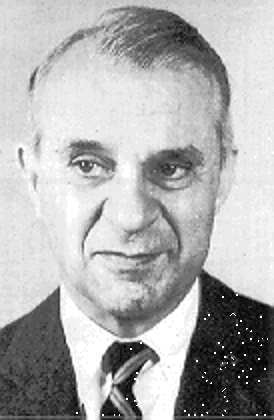
Wassily Leontief was a Russian American economist. He devised input-output analysis, a technique used to analyze inter-industry relationships, for which he was awarded the Nobel Prize in Economics in 1973.
Every industry relies on inputs from other industries to produce its output. For example, a car manufacturer relies on steel, rubber, and electronics. The steel industry in turn depends on iron ore, coal, and other inputs; the rubber industry depends on latex, oil, and so on. Input-output analysis tracks these inter-industry relationships by quantifying the inputs and outputs of each economic sector.
Lawrence White explains: “The analysis might be used, for example, to address the question: If automobile output is to increase [by] 5 percent, how much more steel, electricity, and so on, will be needed as inputs, taking into account such interrelations as the steel industry’s use of electricity?”
This model was developed in pre-independence India and had little bearing on the country’s growth mandate at the time. However, after independence, the country’s leaders faced various challenges in developing a new economic system and addressing the needs of a large and diverse population. At that point Leontief’s model had a critical impact on economic policy. Specifically, P. C. Mahalanobis and others at the helm of the Planning Commission, founded in 1950, used input-output analysis to understand what wage goods and capital goods were required and thereby determined the quantum of investment required across various sectors. The model was also used in formulating India’s first few Five-Year Plans, particularly for industrialization and infrastructure development.