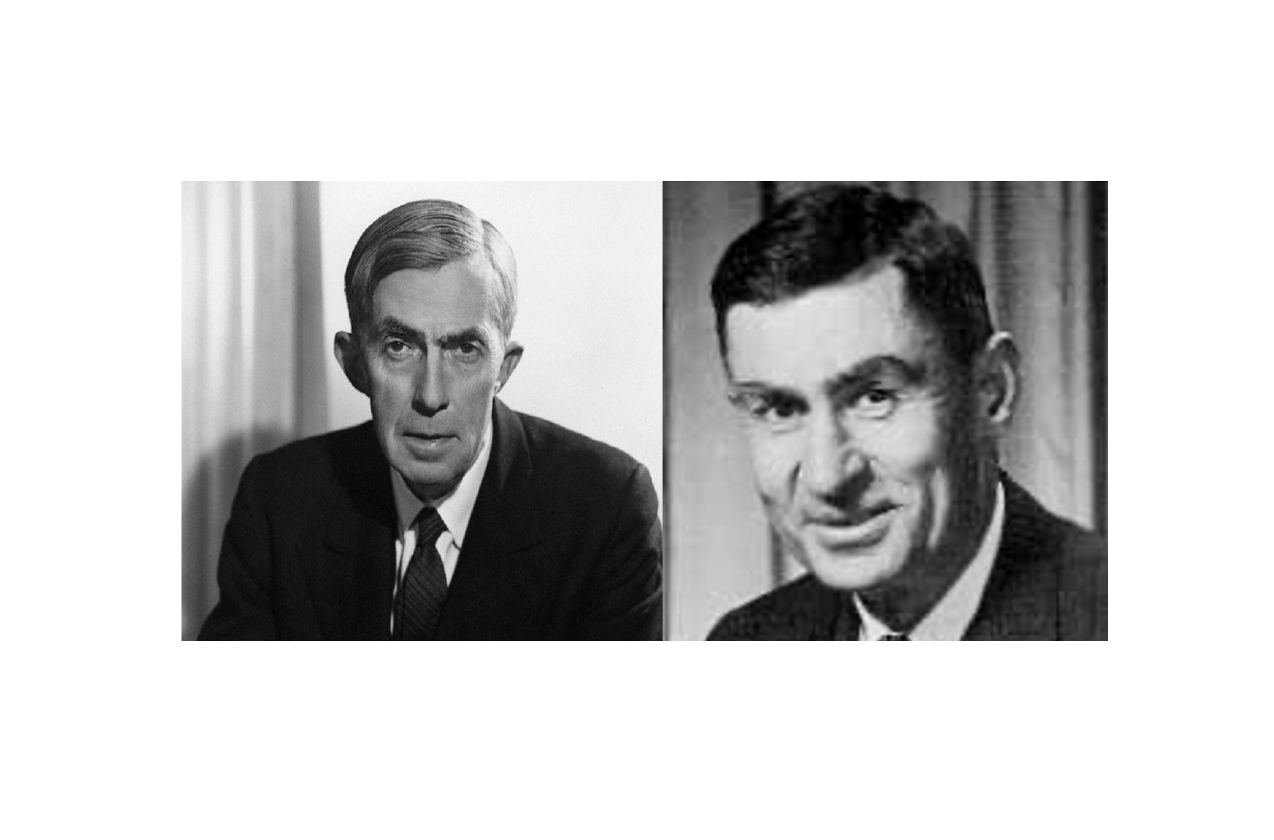

In 1946, the Harrod-Domar growth model comes to prominence. It would later become the basis for India’s First Five-Year Plan (1951–56).
British economist Sir Roy Harrod in 1939 and American economist Evsey Domar in 1946 independently worked on a model that linked economic growth to investment and savings. Today, this model is known as the Harrod-Domar growth model; it suggests that in order to achieve higher growth rates, a country must increase its savings and investment rates, as these will lead to an increase in the capital stock. A larger capital stock will then boost economic growth.
In underdeveloped countries, there is usually an abundance of labor but a shortage of capital. Thus investment needs to not only be mobilized via an increase in savings but also channeled efficiently at a low capital-output ratio to achieve higher growth rates. This ratio is the amount of capital required to produce a unit of output. A higher ratio implies that more investment is required to achieve a given rate of economic growth.
But increasing savings and investment rates can lead to diminishing returns; that is, the marginal productivity of capital decreases as the capital stock increases. This means there is a limit to how much an economy can grow based on investment and savings alone. Further, the Harrod-Domar model does not take into account factors such as technological progress and changes in the labor force.
The model formed the basis of India’s First Five-Year Plan (1951–56). Policy makers believed that the plan would kick off industrialization in the country. It promoted savings and investment through various measures such as tax incentives, subsidies, and greater government spending on infrastructure. Simultaneously, the plan aimed to raise industrial output by setting up new industries, modernizing existing ones, and providing infrastructure utilities such as power and transit networks. The plan was considered a success, as the country outperformed its growth projections.