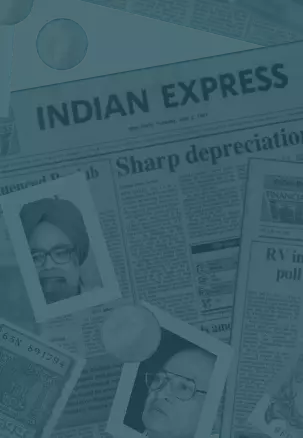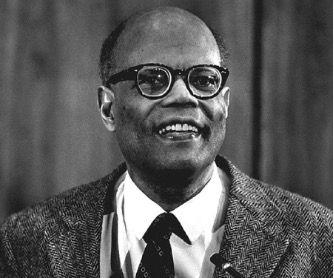

In 1954, Arthur Lewis develops the dual-sector model, which would be used by India’s policy makers for economic planning.
Arthur Lewis was a British economist who developed the dual-sector model, for which he won the Nobel Prize in Economics in 1979. In a 1954 paper, Lewis devised the idea of an economy with two sectors: one that is modern and capital intensive, and another that is traditional and has subsistence wage levels.
Lewis argued that in many developing countries, there is a large pool of surplus labor in the agricultural sector that is available to be absorbed by the industrial sector; it can be treated as an “unlimited supply of labor.” This labor, earning low wages, can keep the cost of industrial production low.
As the industrial sector grows and absorbs the surplus labor, the agricultural sector shrinks in relative size, leading to structural transformation and economic development. When the surplus agricultural labor is exhausted, labor begins to become scarce. Consequently, wages start to rise and can lead to higher inflation rates. This is known as the Lewis Turning Point. At this point, the industrial sector may need to shift its focus from labor-intensive production to more capital-intensive methods to maintain its competitiveness.
The two-sector model has faced several criticisms. One is that it assumes a homogeneous labor force, whereas in reality there are significant differences in skills among workers.[1] Another is that agriculture suffered because of various structural factors not considered in the model.[2] Additionally, the model assumes zero cost in transferring labor between the two sectors; it does not account for potential social and political issues.[3]
In the 1950s and 1960s, Indian policy makers adopted the two-sector model in their economic planning. The government pursued policies to promote industrialization and create employment opportunities in the modern industrial sector. Despite its limitations, the model played an important role in guiding India’s post-independence efforts.
[1] Gollin, Douglas. 2014. ”The Lewis Model: A 60-Year Retrospective.” Journal of Economic Perspectives, 28 (3): 71–88.DOI: 10.1257/jep.28.3.71
[2] Schultz, T. W. (1964). Transforming Traditional Agriculture, New Haven, Yale University Press
[3] Ranis, G. (2004). Arthur Lewis’ contribution to Development thinking and policy, Center Discussion Paper no. 891, Yale University, U. S. ; Harris, J and Todaro, M. (1970). “Migration, unemployment and Development: A Two-Sector Analysis.” American Economic Review, Vol. 40, pp. 126–42.