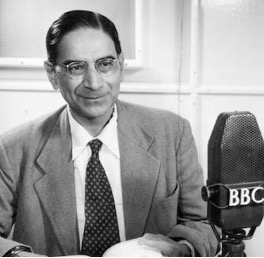

In 1955, P. C. Mahalanobis creates the two- and four-sector models, which would influence India’s economic policy making.
P. C. Mahalanobis was an Indian statistician and economist and is widely regarded as one of the founders of modern statistics in India.
Mahalanobis was a strong advocate of central planning and played an important role in shaping India’s economic policies during the early decades of its independence. He developed the two- and four-sector models of economic planning, which emphasized the need for balanced development across economic sectors.
Policy makers sought rapid growth of the Indian economy through investment in heavy industry. The two-sector model, which Mahalanobis proposed in the early 1950s, divided the economy into capital-goods and consumer-goods sectors and suggested investment should be targeted at the former. His analysis showed that a higher rate of capital formation would enable higher economic growth.
Later, he proposed the four-sector model, which expanded on the two-sector model. The consumer-goods sector was disaggregated into three sectors: factory enterprises, household and small-scale enterprises, and provision of services.
Mahalanobis believed that household and small-scale enterprises would create employment opportunities. The four-sector model, which was tailored to the Indian context, was to be used to determine the distribution of investments, particularly among the consumer-goods sectors. It aimed to analyze the potential growth and employment outcomes of various investment plans. Starting with the Second Five-Year Plan, policy priorities shifted to the development of consumer-goods sectors.
Mahalanobis believed that his models could provide a framework for economic planning in India, as they highlighted the need for balanced development. His ideas influenced the country’s industrialization and modernization path.