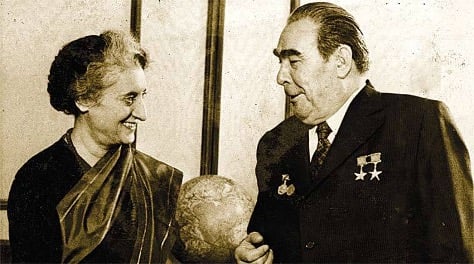

In 1962, India formed closer ties with the USSR, with profound economic implications.
In 1962, amid geopolitical realignments and domestic economic adjustments, India formed a closer relationship with the USSR. This was primarily because the Indian government prioritized inducing export-oriented industries, such as tea and textiles, to service the domestic market (Roy, 2000).[1] This inducement resulted in a contraction of trade volume, which compelled India to seek partnerships with nations that could offer to trade on favorable currency terms.
The USSR emerged as a suitable partner in this respect, as it was willing to engage in rupee-ruble trade. The two nations’ innovative trade agreement allowed India to import goods from the USSR without the pressure of immediately convertible currency payments. This bilateral economic relationship provided an avenue for India to circumvent the burden on its balance of payments that would have resulted from trading in globally dominant currencies.
Further solidifying this relationship, the USSR became a significant partner in India’s industrialization during the 1960s. This deepening partnership inevitably led to the entrenchment of socialist values within India’s economic framework. The central-planning approach of the USSR resonated with India’s own economic strategy. As a result, private companies in India were left with limited freedom to expand and grow.
The closer ties with the USSR thus had profound implications for India’s economy, far beyond trade relations.
[1] Roy, Tirthankar. 2000. The Economic History of India, 1857–1947. Oxford University Press, New Delhi.