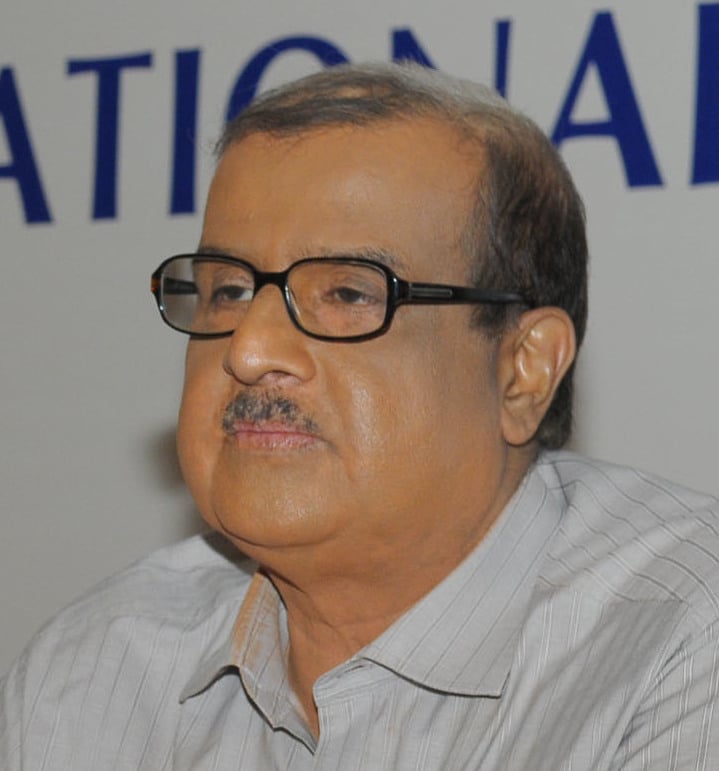

Report of the Committee on Rationalization of Investment Routes and Monitoring of Foreign Portfolio Investments (2013), chaired by K. M. Chandrasekhar
Download as PDF
A report by the Committee on Rationalization of Investment Routes and Monitoring of Foreign Portfolio Investments, led by Shri K. M. Chandrasekhar, Former Cabinet Secretary, Government of India, was commissioned in October 2012 by the Securities and Exchange Board of India (SEBI). Members included Madan Lal Meena (Joint Secretary (Revenue), Department of Revenue, Ministry of Finance, GoI); Atul Kumar Tiwari (Joint Secretary (Financial Services Division), Ministry of Overseas Indian Affairs, GoI); Sanjeev Kaushik (Director (External Markets), Dept. of Economic Affairs, Ministry of Finance, GoI); R. N. Kar (Chief General Manager, Reserve Bank of India); Zia Mody (Senior Partner, AZB & Partners); Bobby Parikh (Managing Partner, BMR Advisors Pvt. Ltd.); Rajeev Luthra (Founder and Managing Partner, Luthra & Luthra Law Offices); Ketan Dalal (Joint Tax Leader, PricewaterhouseCoopers Pvt. Ltd.); Chitra Ramkrishna (MD & CEO, National Stock Exchange of India Limited); Ashish Chauhan (MD & CEO, BSE Ltd.); Gagan Rai (Managing Director, National Securities Depository Limited); P. S. Reddy (CEO, Central Depository Services (India) Limited); Aditya Puri (MD & CEO, HDFC Bank Limited); Mrugank Paranjpe (Managing Director, Deutsche Bank AG); Sudeep Yadav (Managing Director and Head, Citi Transactions Services, Citibank N.A.); Kapil Seth (Head, India HSBC Securities Services, HSBC Bank (Mauritius) Limited); C. R. Sasikumar (MD & CEO, SBI-SG Global Securities Services Ltd.); V. Balakrishnan (Board Member, Infosys Technologies Ltd.); Soumyo Dutta (Treasurer, Reliance Industries Ltd.); S. Nagnath (President and Chief Investment Officer, DSP BlackRock, BlackRock Singapore Limited); Akash Prakash (CEO, Amansa Capital Pte Ltd.); and M. V. Ramnarayan (Director, Link Intime India Pvt. Ltd.).
SEBI tasked the committee with creating guidelines to unify and simplify foreign-investment routes in India. The regulatory landscape at the time was fragmented, with multiple investment routes—Foreign Direct Investment, Portfolio Investment Scheme, and Foreign Venture Capital Investment—leading to inefficiencies, overlapping policies, and increased capital costs. The committee’s mandate was to streamline these investment routes, reduce regulatory complexity, and develop a unified policy for foreign portfolio investments. The proposals were aligned with the FY 2013/14 Union budget, which outlined the need for simpler procedures for foreign investors and the distinction between Foreign Direct Investment and Foreign Institutional Investment based on a 10 percent shareholding threshold.
The committee’s key recommendation was to merge the existing Foreign Institutional Investment, Sub-Account, and Qualified Foreign Investor regimes into a single Foreign Portfolio Investor (FPI) category. This unification would simplify market entry, monitoring, and reporting norms for foreign investors. The committee recommended that individual FPI shareholdings not exceed 10 percent of a company’s paid-up capital, while aggregate FPI shareholding should be capped at 24 percent, unless a lower sectoral cap applies. Monitoring these limits would be the responsibility of Designated Depository Participants. Furthermore, the committee recommended adopting a risk-based approach to Know Your Customer compliance, classifying FPIs into three risk categories—government-related entities (low risk), regulated funds (moderate risk), and unregulated entities like family offices (high risk). To ease compliance, it proposed that category I and II FPIs be exempted from stringent Know Your Customer norms, while category III entities would face stricter requirements.
The committee also addressed operational and legal changes necessary for implementing the FPI regime. It recommended amendments to SEBI regulations, the Foreign Exchange Management Act, and the Income Tax Act to accommodate the new structure. The report emphasized that foreign portfolio investments should be allowed only in listed equity securities and that private placements in unlisted companies should continue to be classified as foreign direct investment. Additionally, the committee recommended that the Foreign Venture Capital Investment regime be retained and expanded to cover more sectors, while existing custodians and Qualified Depository Participants should be given a one-year period to comply with the new Designated Depository Participant eligibility criteria. Taxation of foreign investors would shift from a source-based to a residence-based system, aligning India’s tax policies with international norms. By harmonizing investment routes and reducing the regulatory burden, the committee aimed to make India a more attractive destination for foreign portfolio investments.
The committee’s key recommendations, such as merging Foreign Institutional Investment, Sub-Account, and Qualified Foreign Investors into a single FPI category and introducing risk-based Know Your Customer norms, were accepted and implemented via SEBI’s 2014 regulations. The committee also introduced caps on FPI shareholding (10 percent individual, 24 percent aggregate). However, the proposed shift to residency-based taxation remains pending government action. The committee addressed the inefficiencies of a fragmented regulatory framework by proposing the unification of investment routes, risk-based compliance norms, and operational reforms, to simplify foreign portfolio investments and enhancing India's appeal as a destination for global investors.