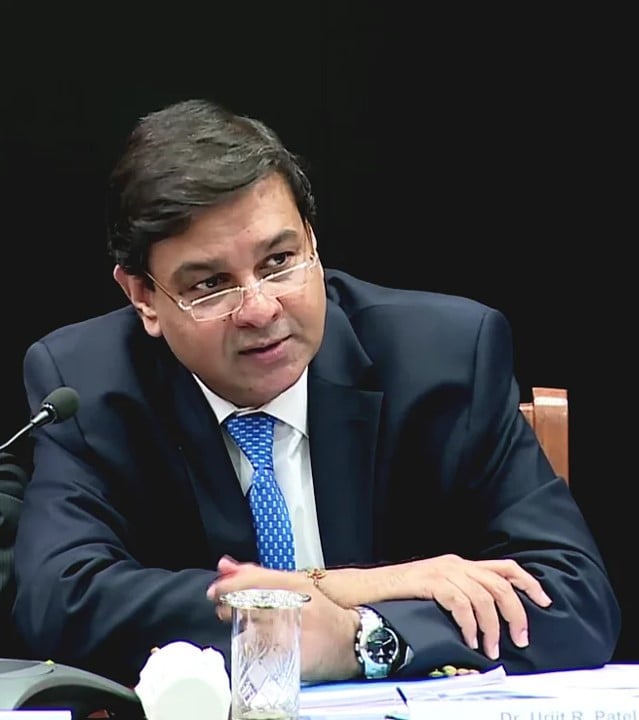

Report of the Expert Committee to Revise and Strengthen the Monetary Policy Framework (2014), chaired by Urjit Patel
Download as PDF
In the aftermath of the Global Financial Crisis, India had one of the highest rates of inflation among the G-20 countries, and it experienced increased macroeconomic volatility as a result of variations in capital flows and, consequently, exchange rates. In 2013, Raghuram Rajan, Governor of the Reserve Bank of India (RBI) commissioned the Expert Committee to Revise and Strengthen the Monetary Policy Framework in India, to be chaired by the Deputy Governor, Dr. Urjit Patel. Members included P. J. Nayak; Chetan Ghate (Associate Professor, Economics and Planning Unit, Indian Statistical Institute); Peter J. Montiel (Professor of Economics, Williams College); Sajjid Z. Chinoy (Chief Economist and Executive Director, J.P. Morgan); Rupa Nitsure (Chief Economist, Bank of Baroda); Gangadhar Darbha (Executive Director, Nomura Securities); Deepak Mohanty (Executive Director, Reserve Bank of India); and Michael Debabrata Patra (Principal Adviser, Monetary Policy Department, Reserve Bank of India, Member Secretary).
The report indicated that after the Global Financial Crisis, long-term household inflation expectations increased by approximately 150 basis points, contributing to negative real interest rates for savers and a decline in domestic financial savings. The report highlighted India’s persistent high inflation and sluggish growth in the postcrisis years, necessitating a reevaluation of the monetary policy framework. It emphasized the consequences of high inflation, including negative real interest rates, erosion of external competitiveness, and increased demand for gold as an inflation hedge, exacerbating the current account deficit and vulnerability to external shocks.
Per its terms of reference, the committee recommended that the RBI adopt inflation targeting as the monetary policy framework, with the combined-Consumer Price Index, which combined the indices for rural and urban prices, being the nominal anchor. The annual inflation target it recommended was 4 percent +/−2 percent. It proposed a phased refinement of the monetary policy operating framework. In phase I, the weighted average call rate would serve as the operating target, with the overnight Liquidity Adjustment Facility repo rate as the single policy rate and with liquidity management through term repos and overnight repos. In phase II, the 14-day term repo rate would become the operating target, supported by a spectrum of term repos to enhance policy transmission across markets. The introduction of new instruments, such as a remunerated standing deposit facility, and the phasing out of sector-specific refinance facilities, the Market Stabilisation Scheme, and cash management bills were also recommended.
Among the institutional requirements for the proposed monetary policy framework, the report emphasized the need to keep the ratio of the central government’s fiscal deficit to GDP at or below 3.0 percent, consistent with the Fiscal Responsibility and Budget Management Rules. It also called for eliminating administered setting of prices, wages, and interest rates by the government. The committee also recommended that the use of open market operations be limited and only engaged in for the purpose of liquidity management, not for fiscal reasons.
The Urjit Patel Committee’s recommendations led to significant changes in India’s monetary policy framework. Key accepted recommendations include adopting the Consumer Price Index as the nominal anchor and setting an inflation target of 4 percent with a +/−2 percent band, both formalized in 2016 by amendment to the RBI Act of 1934. The Monetary Policy Committee, comprising the RBI governor, deputy governor, and executive director and three external members, was also established, and it would meet every two months. The Monetary Policy Committee would be held accountable by having to issue a signed public statement upon failing to meet the inflation target and having to submit a letter to the Parliament explaining the reasons for failure. However, recommendations to eliminate administered prices, wages, and interest rates and to discontinue the Market Stabilisation Scheme and cash management bills were not fully adopted.
The report addressed India's challenges of high inflation and macroeconomic instabilityafter the Global Financial Crisis, recommending an inflation-targeting framework anchored to the Consumer Price Index and institutional reforms to enhance monetary policy effectiveness. Its key recommendations, including inflation targeting and the establishment of the Monetary Policy Committee, were implemented, marking a significant shift toward a more accountable and transparent monetary policy framework.